

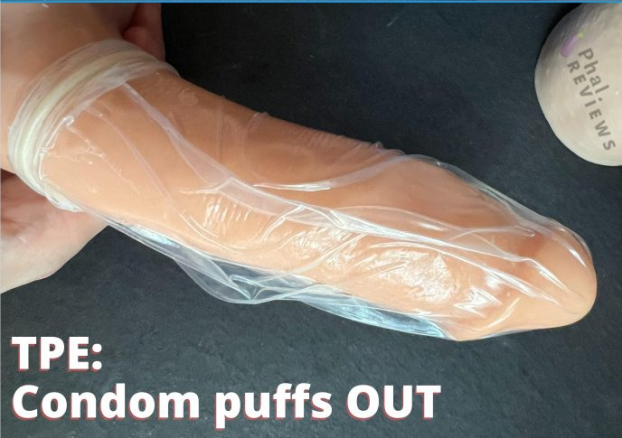
1.TPE & PVC Dildos Damage Condoms
First, let’s look at what a porous dildo does to a latex condom, vs. how a silicone dildo does not affect the condom:

This recurred over and over, anytime I put any latex condom on the Ultraskyn dildo. Note that the maker says about these TPE toys: “the most realistic feeling cocks on the market today. Doc Johnson strives for realism and perfection in crafting these.” Uh…no. I’m gonna go out on a limb here and say, the lowest possible bar for “perfection” should be “will not breed bacteria if I keep using it.”

So TPE is not great, but PVC is the worst sex toy material that money can (unfortunately) buy. Even though some brands are claiming their PVC dildos, plugs, etc. are “phthalate-free” now, the PVC used in toys requires a plasticizer, or softener, to make it not rock-hard. Many different plasticizers may be used. Sex toy companies do not disclose what their specific plasticizer is, nor do they show proof that it’s not the cheapest option: phthlates.“Is Wetter Better? An Evaluation of Over-the-Counter Personal Lubricants for Safety…,” PLoS One [Public Library of Science peer-reviewed journal], 2012." title="">1 Phthalates have been bannedmust be a very low level, 0.1% or less concentration in the whole product." title="">2 in children’s toys, but not in adult toys!
It is possible for PVC dildos to be softened with altered mineral oils (like soybean oil), but no companies have ever come forward to give specific material data demonstrating they do use mineral oil, rather than phthalates.
TPE dildos are thermoplastic elastomer a.k.a. thermoplastic rubber. These toys most commonly include petroleum oil to get a “soft and fleshy” feel.online at Science Direct.com." title="">3 I have heard one manufacturer’s representative non-publicly state that the toy company used “high quality” soy oil in their TPE toys—in any case, some type of oil is found in TPE dildos. To further confuse the issue, big sex toy companies may not clearly state that TPE toys are made from TPE. They’ll call TPE/TPR by confusing names like:
- “Ultraskyn” (Doc Johnson) [formerly “UR3”],
- “Cyberskin” (Topco),
- “Fanta Flesh” (Pipedream),
- “Superskin” (Fleshlight),
- “soft plastic” (Lovehoney).4
TPE toys are not toxic immediately, but they are quite porous: So they do degrade over time, and they’re much more likely to allow for bacterial, fungal, and viral growth as time passes; or when they’re left wet or in the heat or sunlight. PVC toys are also porous, and may be toxic—again, toy companies just don’t release info on exactly what plasticizers they use.
I know I care about my vagina not getting a painful infection: So body-safe silicone, metal, glass, and ABS plastic toys5 are the healthy options in the long run. Silicone does cost a bit more, but it doesn’t have to be exorbitant: Here’s a selection of silicone dildos under $50, or vibrators under $50.
You saw my condom-degrading dildo, above: Doc Johnson’s Ultraskyn TPE causes the latex condom to puff up within an hour of exposure. A more expensive latex condom (Wink by Okamoto) survived some stroking for a few minutes, before it tore; while a while a Crown latex condom tore right in half the first time I stroked it downward. Silicone dildos don’t cause condoms to puff up & enlarge:

Remember, TPE damages latex because TPE seeps out oil! Oil and latex are at war:
2. Oil-Based Lubricant and Condoms Don’t Mix!
If you’re using condoms for protection during sex with a partner, don’t use oil-based lubricant. That includes any ingredient with “butter” in the name.
I found this out once with The Butters lube, made primarly of shea butter, cocoa butter, and coconut oil. We were getting into anal sex, and my erstwhile husband had switched from penetrating me vaginally to penetrating me anally, the condom still on his dick. The shea/cocoa/coconut oil lube was in my butt. We realized the condom had torn only after he came and pulled out of my ass.
Similarly, it takes a few minutes of stroking a condom-ed dildo with an Ah Yes! natural sunflower seed, shea butter, almond oil lube before it starts to tear. That’s a great lube for cutting friction by itself: just don’t use it with latex condoms.

Interestingly, I found that pure coconut oil didn’t cause latex condoms to rip that I can actually see—after a limited use time, about 3 minutes. Longer use, or more stress like from anal use, can tear a condom that’s been coconut-oiled. So I would not recommend coconut oil on latex condoms if you need the condom to remain intact for safety reasons, like STI prevention or contraception. It’s too risky.
But what about toys that don’t leach oil: Can you use condoms on silicone sex toys?
3.Silicone* Sex Toys Are Safe with Condoms
Yes, silicone is a safer (more nonporous) material that doesn’t degrade latex or non-latex polyisoprene (Skyn) condoms. I’ve even written about why you might choose to use a condom on a [silicone/body-safe] toy: like, to prevent butt odors on anal toys, and to make anal cleanup faster.
But silicone + latex condom mixtures carry a couple precautions. Condoms almost always have silicone lubricant already inside them. So some people will choose to use only (rare) non-lubricated condoms on silicone toys, because:
Silicone Lube Is Rough on Silicone Toys!
Silicone lube is tougher to clean off silicone sex toys. Like, it can be sticky-gooey = lots of scrubbing. Indeed, this section will have less photos, because I’m avoiding the extra cleanup of pouring silicone on silicone  .
.
With pure silicone products (100% silicone dildos & butt plugs), silicone lubricant is unlikely to degrade the cured silicone toy. Makers like Mr. Hankey’s Toys,FAQ #17." title="">6 SquarePegToys,calls it a “myth” that silicone lube degrades pure silicone toys; SquarePegToys does state, “Silicone lubes are the most persistent” (i.e., hardest to clean off silicone sex toys)." title="">7 and NS NoveltiesColours Vibrating and Colours silicone dildos in general." title="">8 will all publicly state that their silicone products are fine with silicone lubricant.
One indie maker I respect, Pleasure Forge, lightly disagrees, saying the silicone-on-silicone combination “is not usually recommended.”
But with silicone vibrating toys where there’s a very thin layer of silicone over a motor core, you can see swelling when you add silicone lube sometimes. Maybe even degradation, if the silicone is cheap enough: Like that one time I tried pure silicone lube on an XR Brands thrusting plug. Part of the surface felt scratchy for ever after. So, this is a big reason why larger manufacturers may recommend against silicone lube—in order to ward off any possible related customer complaints. It’s like how they may label their dildos, butt plugs, and rabbit vibrators “for external use only.” (Like, just for liability’s sake.) A few toy companies, like Fun Factory, will not warranty defective vibrators if you say you’ve used silicone or oil-based lubricant on the product.
So it really depends on the toy: Usually the solution offered (if you’re unsure about whether you can use silicone lube on a particular silicone toy) is to do a “patch test.” Meaning: you apply a noticeable spot (maybe like dime-sized) of silicone lubricant to the base of a silicone toy, leave the lube on for a while, then come back and wipe off and wash off the lube. The thought is that if any damage is visible, or you can feel a different texture than before, don’t use silicone lube with that particular toy; otherwise, it’s safe.
But: I recommend, never use silicone + oil lube blends on silicone dildos. Especially this one by Intimate Earth, Ease Anal, which is 4 silicone compounds plus sunflower oil & plant extracts. Yikes, that stuff does not come off. It is like glue on silicone. Woe is the day I accidentally put that on my favorite vibrator!
Are Hybrid Lubricants Safe on Silicone Sex Toys?
Yes. Personally, I avoid silicone lube on silicone toys, due to the sticky cleanup. I do use a hybrid lubricant, the next-thickest, nongreasy option. Hybrid lubes have low silicone content (they’re over 90% water-based) and are much, much easier to clean off.

I’ve never, ever over the years heard of anyone seeing hybrid lube damage a real-silicone toy. I’ve used it myself on many dozens of products, from pure silicone dildos and plugs, to thin-silicone-coated vibrators. Sliquid Silk is the option I’ve found with the lowest osmolality (to not mess with vaginal & rectal cells’ protective outer barrier, the epithelium); so I feel most comfortable using Silk.
Summary
Important tips for playing as safe as possible = more fun in the long run!
- PVC and “real feel” TPE/TPR dildos degrade condoms.
- PVC and TPE/TPR toys are more porous, so they allow microbes9 to grow on/in them.
- Oil-based lubricants degrade condoms, whether on a penis or a dildo.
- Silicone toys do not degrade condoms.
- But the silicone lubricant on condoms may affect some silicone sex toys.
- Indeed, silicone lubricant is difficult to clean off silicone toys. In some cases, but not others, it may stick so much that it damages the toy or just cannot be washed off.
- Use hybrid lubricant on silicone toys if you want a thicker lubricant. It will not hurt the silicone.
- Oil-based lubricants don’t degrade silicone toys. They can stain sheets, and require more scrubbing (with soap and water) to clean off [than water-based or hybrid lubricants require].
NOTES
- Whereas with silicone toys, the softening agent is always dimethicone, a.k.a. polydimethylsiloxane or PDMS, which is silicone-based, and is used in all silicone lubricants. Dimethicone lubricant is generally considered safe, as “silicone-based products showed no effect on tissue viability or the epithelium [protective outer cell layer]… Nearly iso-osmolar [water-based] and silicone-based lubricants were the safest for epithelial cells and mucosal tissues” in both the vagina and the rectum, according to a wide-ranging study on lubricant safety: Dezzutti et al., “Is Wetter Better? An Evaluation of Over-the-Counter Personal Lubricants for Safety…,” PLoS One [Public Library of Science peer-reviewed journal], 2012.
- Essentially: The phthlate content must be a very low level, 0.1% or less concentration in the whole product.
- “Petroleum oils are the large volume plasticizer used in elastomers,” from B.L. Wadey, Encyclopedia of Physical Science and Technology, 3rd ed., snippet online at Science Direct.com.
- This is IMO the worst, since a customer may read “plastic” and assume ABS plastic, which is a hard, durable material that doesn’t have porosity problems.
- Other firm options that can be safe when they have a completely smooth, nonporous finish: stone (rare), ceramic (also rare, and don’t drop it!), and wood (if thoroughly sanded and finished with specific skin-safe varnishes).
- In FAQ #17.
- Which calls it a “myth” that silicone lube degrades pure silicone toys; SquarePegToys does state, “Silicone lubes are the most persistent” (i.e., hardest to clean off silicone sex toys).
- Their silicone toys are “suitable with all lubricants,” in NS’s phrasing. See toys like Colours Vibrating and Colours silicone dildos in general.
- Microbes is an umbrella term for all microorganisms, including bacteria, fungus/mold/yeast, and viruses. Some microbes are found naturally in the body, but then become pathogenic (harmful or painful to their human host) when they overgrow in the wrong area, like during a vaginal yeast infection.


